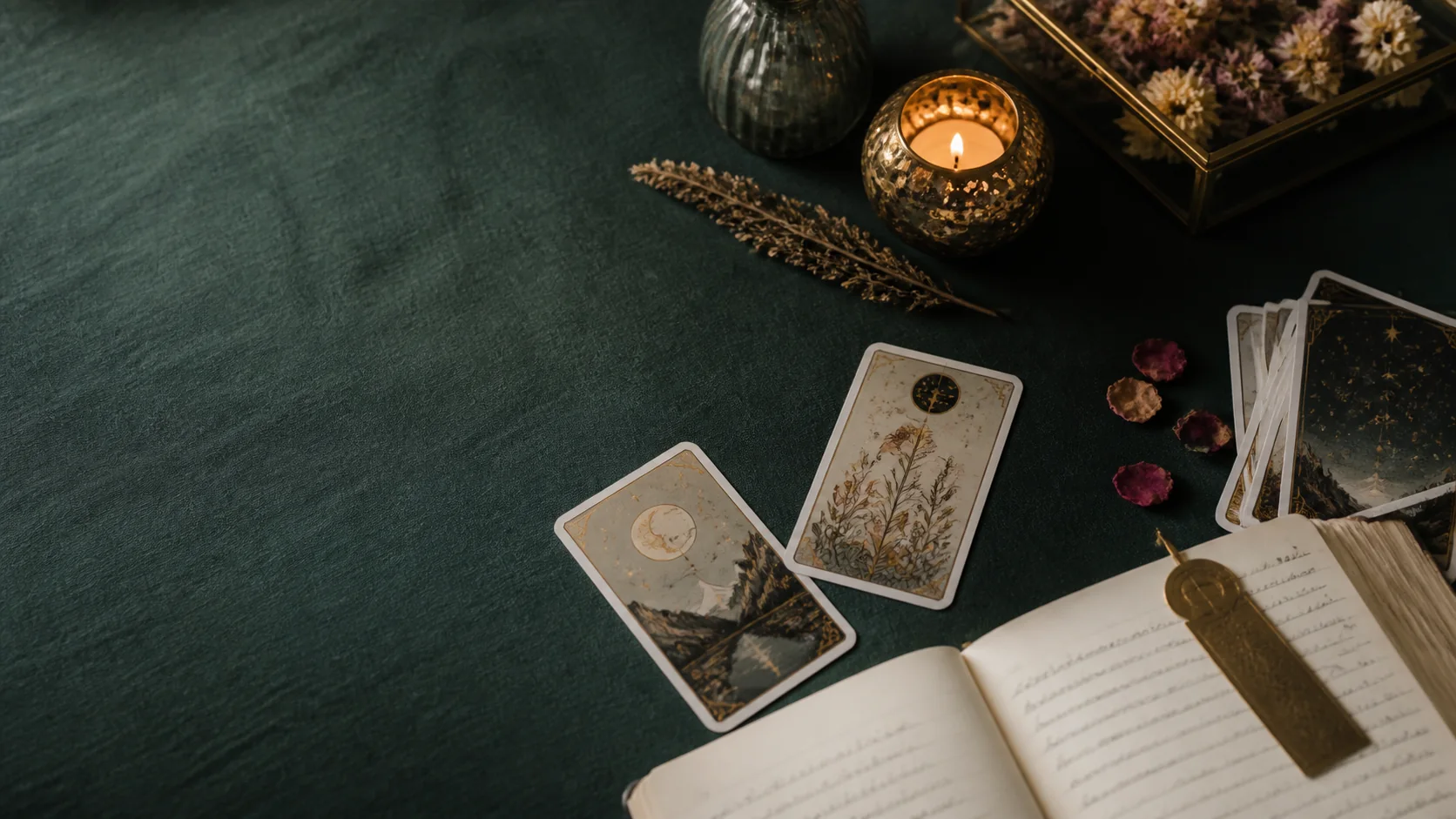
Learn to Hear What the Card Is Actually Saying

You’ve pulled a card before — your own, a friend’s, an app’s daily draw — and walked away unsure what to do with it. The Tarot Tells teaches card language first: how a card’s image, its position and the cards sitting next to it combine into a message you can read yourself, including the cards you’d rather not hear from.

dotted card outlines and a constellation motif for tarot card language

A card meaning isn’t a single fixed word. It’s built out of four things at once: what the image is literally showing you, where the card landed in your spread, which cards it’s sitting beside, and whether it came up upright or reversed. Most confusion about tarot comes from treating a card like a vocabulary word instead of a sentence.

We don’t sell readings, and there’s no roster of readers to book. What we offer instead is plain-language instruction in reading a card the way it was actually built to be read, plus a free-reading tool if you’d rather have the message drawn for you first and explained afterward.

This site used to run under the same domain as a booking page for live readers, complete with invented biographies and star ratings of competing services. We kept the name because the idea behind it is worth keeping — a tarot card genuinely does tell you something, if you know how to listen — but we dropped everything else. There is no team to meet here, no client roster, no track record to cite. What’s left is the part that was actually useful: a plain explanation of how a card’s language works.

Every page on this site follows the same rule: describe what the card is doing before deciding what it means. That order matters more than it sounds like it should. Skip straight to the keyword and you’ll miss the parts of the message that the keyword was never built to carry — the tone of the picture, the direction a figure is facing, the number of objects in the frame.

What people say once a card finally makes sense

Given what this site used to be, we’re not going to turn around and invent a client roster of our own — the lines below are written to sound like this site’s readers, but they aren’t quotes pulled from anyone real.

“I’d read the Nine of Swords a dozen times as ‘anxiety, full stop.’ Learning to read the position changed how I look at every hard card now — it’s not a verdict, it’s a snapshot.”

abstract dotted badge icon representing a site visitor

a returning reader

“Every other tarot site either terrifies you about the Tower or pretends it’s secretly great news. This is the first one that just explained what the picture is doing.”

abstract dotted badge icon representing a site visitor

someone new to reading their own draws

“I stopped needing someone else to translate my own cards for me. That’s a strange thing to say about a website, but there it is.”

abstract dotted badge icon representing a site visitor

a daily-draw app user

The Vocabulary

The Four Suits, At a Glance

There’s no roster of readers here to pick from — instead, here’s the vocabulary a card is built from. Every minor-arcana card belongs to one of four suits, and each suit has its own register, the way a language has moods.

line-art cup icon representing the suit of cups

Cups

The feeling register — love, grief, attachment, intuition. Cup cards describe an emotional state, not an event, so a Cup card next to a hard Sword usually means the feeling is about to meet a hard truth.

line-art sword icon representing the suit of swords

Swords

The thinking register — conflict, clarity, hard truths. This is where the deck’s scariest-looking cards mostly live, and where plain reading matters most, because a Sword card is almost always describing a thought pattern, not a punishment.

line-art coin icon representing the suit of pentacles

Pentacles

The material register — work, money, health, the body. Pentacle cards talk about what’s built or spent, slowly, over time, so they answer “is this sustainable” more often than they answer “will I get rich.”

line-art wand icon representing the suit of wands

Wands

The drive register — ambition, energy, momentum, risk. Wand cards describe what you want to do, and what’s fueling or draining that want, which is why they show up so often around career pivots and new starts.

The Method

How to Read a Card in Three Passes

This is the same sequence we use whether you’re reading your own draw or using our free reading tool. It works on any card, in any spread, including the ones that look bad.

1. Read the Picture Plainly

Before you reach for the keyword you memorized, describe what’s literally happening in the image, like you’re describing it to someone who can’t see it. A figure walking away. Ten blades stuck in a back. A cup overflowing. That description is usually 80 percent of the real message, and it works even if you can’t remember the card’s name or its supposed keyword at all.

2. Place It in Position

The same card means something different in a “what’s ending” slot than in a “what’s coming” slot. A single card pulled with no spread at all is answering the plain question you asked it — nothing more, nothing less. Position is the single most skipped step in a rushed reading, and it’s usually the one that would have changed the whole interpretation.

3. Check the Neighbors

A hard card next to a hopeful one softens; a hopeful card next to two hard ones gets a reality check. Reversal is the same idea turned inward — the same message, but pointed at you rather than your circumstances. Read all three passes together and most “contradictory” spreads turn out to be perfectly consistent once you notice what each card is actually responding to.

What Kind of Questions Suit This?

Card language works best on questions with room to move — a situation you can look at from more than one angle, not a single fact waiting to be confirmed. If your question has a yes-or-no shape, that’s fine; the cards will still answer it, but the answer comes as a direction, not a countdown.

Reads well:

  • “What is this relationship actually asking of me right now?”
  • “What’s the honest read on why this keeps stalling?”

Doesn’t translate:

  • “Will they text me back today?” (too narrow a moment for a symbol to answer)
  • “What’s the exact date this changes?” (cards read direction, not calendars)

A useful trick when a question feels too narrow: widen it by one step. “Will they text me back today” becomes “what does this waiting period say about how I’m handling uncertainty” — same worry, but now there’s an actual pattern for the cards to describe instead of a single yes-or-no moment they were never built to pin down.

three overlapping card-back outlines illustrating how neighboring cards change a reading
a single dark card outline with a dotted upward arrow representing a reversed card

Reading a Card You Don’t Want to Hear

The Tower, the Ten of Swords, Death, the Three of Swords — these cards get treated like a verdict because they’re drawn to look alarming. Read plainly, most of them are about timing and endings, not punishment. The Tower is a structure that was already cracked, coming down fast rather than slowly. The Ten of Swords is the bottom of something, which is a different place than the middle of it.

Death is probably the most over-dramatized card in the deck, and the least literal. It is almost never about a person dying — it’s about a phase that has actually finished, even if you haven’t admitted that yet. The Three of Swords looks like heartbreak because it is heartbreak, but its message is closer to “name the pain plainly” than “this pain is permanent.” None of these cards are trying to frighten you into a decision. They’re trying to describe where you already are.

The practical move with a hard card is the same every time: name what it’s actually showing, separate that from the panic the picture is designed to provoke, and ask what one honest action would follow from the plain version. That third step is where a reading stops being theater and starts being useful — a card that says “this has already ended” is only frightening until you notice it’s also giving you permission to stop pretending otherwise.

We won’t tell you a hard card is secretly good news, and we won’t tell you it’s a doom you can’t avoid. We’ll tell you what it’s actually pointing at, plainly, and let you decide what to do with that.

What We Won’t Do

Reading, Not Prophecy

This domain used to run as a live-reader marketplace with invented reader biographies and star ratings of other reading services. None of that is here anymore. We don’t claim credentials, certifications, years of practice, or a client count for anyone connected to this site. We don’t rate or review other reading platforms. Every explanation here is framed as a reading of a symbol — never a claim about what will happen, never medical or financial guidance, and never a guarantee dressed up as insight.

If a page ever slides toward telling you what to do instead of what a card is pointing at, that’s a mistake on our end, not the method working correctly — tell us and we’ll fix the wording. The whole premise of card language is that you keep the authority over what the reading means for your actual life; we only handle the translation.

Why This, Not a Reader

Why Learn Card Language at All

Booking someone to explain your cards works, but it puts a translator between you and your own deck every single time. Learning the grammar means the next daily draw, the next three-card pull, the next hard card at 2am doesn’t have to wait on anyone else’s schedule. You still get the option of a free reading if you’d rather have it drawn and explained for you first — this just means you’re not stuck needing that forever.

There’s also a quieter benefit: once you can read a card yourself, you stop outsourcing the emotional weight of the reading to whoever explained it to you. A stranger’s tone of voice, their choice of words, their own mood that day — none of that should be part of what a card is telling you, and it usually is, whether the reader means it to be or not. Reading the symbol directly removes that extra layer.

It also means you can tell the difference between a card that’s genuinely warning you about something and a card that just has a scary picture. That distinction is most of what a good reading actually is.

A Short Glossary

Five Words Worth Knowing First

You don’t need to memorize seventy-eight card meanings to start reading well. You need these five terms, because almost every confusing sentence on a tarot site turns out to be leaning on one of them without explaining it.

Frequently Asked

Is this the same as a psychic reading?

No. We teach how tarot’s own symbol system is built and read. Nothing here claims to know facts about your future — it explains what a card’s imagery, position and pairing are pointing at.

Do reversed cards mean the opposite?

Rarely a flat opposite. Reversal usually turns the message inward — a card about outside circumstances becomes a card about your own resistance, delay or blind spot around the same theme.

Why do so many sites disagree on what a card means?

Because most list a single keyword instead of teaching the grammar. Once you can read image, position and neighbors together, the disagreements mostly resolve — they’re describing different pieces of the same sentence.

Can a reading tell me what will actually happen?

No, and nothing on this site claims otherwise. A reading describes a pattern worth noticing, not an outcome. Treat every card as a way to think out loud, not a forecast.

Is a “bad” card actually bad?

Almost never in the way the picture implies. Most feared cards are about timing, transition or an uncomfortable truth — see our full guide on reading hard cards for the honest, de-catastrophized version of each one. The picture is drawn to get your attention, not to tell you the worst has already happened.

Do I need my own deck to use this site?

No. Plenty of visitors arrive holding a card from a friend’s deck, a daily-draw app, or nothing more than a phrase they half-remember from years ago. The card-language method works the same way regardless of where the card came from — it’s about how to read the symbol in front of you, not about owning a particular deck.

Ready to Hear What Your Card Is Saying?

Draw a free card, or bring the one you’re already holding — from your own deck, a friend’s, or a daily-draw app. Either way, you’ll get a plain reading of what it’s actually saying — no ratings, no invented résumé, no guarantee about tomorrow, just the picture, the position and the neighbors, read honestly.